Friday, April 20, 2012

Mirror Mirror

I admit I was not the most enthusiastic of fairy-tale-enthusiasts when I saw the trailer for Mirror Mirror, with its heavy dose of Julia Roberts (of whom I am not a big fan) and seemingly endless slapstick.


But my interest piqued when Once Upon a Blog: Fairy Tale News posted about a very different review that the film had gotten: one comparing the plot to the real life assassination of Indira Gandhi. Suddenly that outrageous swan dress didn't seem so off-putting, and Julia Robert's half-assed attempted accent was something I was just going to have to bear with.

So I coaxed (paid for) one of my friends to accompany me to the little local theater and we sat through the previews talking about how horribly wrong fairy tale adaptations could go. (I'm looking at you, Red Riding Hood.)

And honestly... I ended up really enjoying this film. If nothing else, it's worth going to see in the theater for the lush costumes and stunning set work.

Photobucket

Once I found out about the Indian ties (maybe the director's name should have been my first clue...) it was impossible not to see all the Bollywood Influence. (And I like Bollywood movies; if you're not a fan then I'm not sure how you'd feel about the movie, generally, but it's still interesting from a scholarly/cultural perspective -- always nice to see fairy tales that aren't entirely Western-cultural.)

I think the best way to describe this movie is... kind of cartoony. It's tongue-in-cheek through and through, with the prince even commenting on focus groups. It's hard to say it takes itself seriously, yet it drew me in enough to care about the characters (except the queen, and I'm not supposed to care about her anyway, right?), and I was impressed with the time spent to develop some of the secondary characters, like the dwarves and Snow's mentor Margaret. A lot of fairy tale retellings, especially in film, skim over secondary characters to the point where they are interchangeable.

Photobucket

For me, the biggest downfall of the movie was Julie Roberts, which is no surprise. But even my friend said the accent was pretty atrocious: everyone else seemed perfectly happy to just speak in their native accent but Roberts waffled back and forth between a vaguely British slur to her normal American vocalizations. And honestly I do not feel like the woman understands comedic timing or any of the other fine-tunings that come with getting a laugh out of an audience. If you are a fan of hers this might not be a problem for you so I'll leave it at that.

If you prefer darker retellings, this one won't hold as much appeal -- though I think that Indian Assassination angle is worth looking into (which I honestly haven't done, but hey I am a light scholar at best). Here is one other blog post, from pinayredeemed.blogspot.com, drawing the parallels between the political situation and the movie.

So should you see this? If you are a fan of the Snow White story, yes. This has enough of its own twists to be worthy of a viewing; Tarsem Singh does draw in the modern sensibilities of women rescuing themselves and in the end it's easy to cheer for this Snow White. Should you see this in the theater? I would encourage it -- like I said, the costumes are fabulous and the scenery is just yummy.

Tuesday, April 17, 2012

Fairy Tale Fortnight

It's been pretty quiet around here, and I'm honestly not sure when and how my schedule is going to settle down. I'm not going away though reviews will be somewhat irregular for the near future.

However, if you need your fairy tale fix, head over to The Book Rat blog where Fairy Tale Fortnight is going on RIGHT NOW. There are lots of giveaways, reviews, videos, and more. Check it out! I insist!

Sunday, April 1, 2012

Gnomeo and Juliet


It's Red vs. Blue in this retelling of Shakespeare's
Romeo and Juliet. The star-crossed lovers take the form of ceramic garden gnomes in the 2011 CGI film Gnomeo and Juliet.


I was somewhat afraid that they would take the names and that would be the extent of the relation to the play, but it does follow the essential storyline of R&J. There are a few changes; the gnomes don't mix at a party, for instance, but Gnomeo runs into Juliet when she's cat-burgling an orchid for the Red's garden. Their first encounter is more of an acrobatic flirtation than a traditional dance.

There are a lot of great Shakespeare references for the aficionados as well as slapstick for the kids. (Honestly, I was pretty nervous throughout from the tinkling of ceramic in motion.) It all follows the story pretty closely -- included a ceramic shattering of Juliet's cousin Tybalt. Gnomeo gets chased away to the park where he encounters, in one of my favorite scenes, the statue of Shakespeare, who explains how the story is supposed to go, and why it's such good writing.

Although Gnomeo is the one who has the knowledge to possibly change their tragic fate, it doesn't come across too much as male heroics. I don't think I can spoil the ending -- it is a kids' movie, after all -- but I won't say anything more specific than that.

In spite of being, as I said, nominally a kids' movie, the pacing is good, and there are lots of puns and plenty of humor for the adults to catch. Shakespeare references, from other plays as well as R&J, abound, and the writing is sharp throughout. The casting is good, and the animation -- while veering more toward cartoonish than realistic -- was well done and fitting. I was completely charmed by this movie.


Friday, March 30, 2012

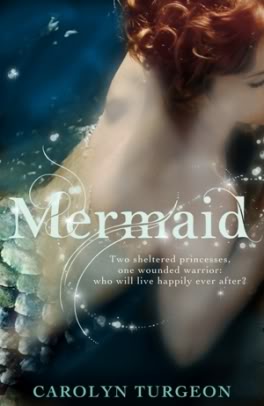
Mermaid by Carolyn Turgeon

Mermaid, by Carolyn Turgeon, is an adaptation of Hans Christian Andersen's The Little Mermaid. It's often labeled as "a twist on the classic tale" but I felt it was more of an expansion with a little bit of a twist at the end. It considers both princesses -- the mermaid princess, and the other princess whom the prince falls in love with -- and tells the story through them. It sticks closely to the bones of the Andersen tale through most of the story and only diverges in the last quarter or so, once the human princess (Margrethe, in this version) reaches the prince.

The value in this story comes from the fact that there is no real "bad guy" in play -- both princesses love the prince, and he's conflicted for both personal and political reasons, making this one of the more complex retellings of the story. Even the sea witch is not evil or motivated by greed or malice: she warns Lenia (the young mermaid) that it is a terrible thing to lose a part of oneself, but leaves the choice ultimately up to the mermaid princess.

The book was shorter than I expected, given the complexity of the situation, and I found the writing to be overly formal. On the other hand, since it was adapted from Andersen's story, it makes sense that Turgeon would use similar language. Turgeon does give the main characters complexity and depth, but I would have liked to see that from a few of the other characters, and would have appreciated a little more world-building. There are hints of it within the undersea kingdom, but it's never filled out in the story.

It has the same problem that all versions of this story have to a modern audience: a young woman giving up her life, family, and greatest asset to be with a man (who doesn't even know she exists). Turgeon does manage to give Lenia something else to live for in the end, and this becomes more of a story about two women saving each other than a romance or a story of a heroic prince or tragic princess.


Wednesday, March 28, 2012

A Pearl Among Princess by Coleen Murtagh Paratore

A Pearl Among Princes, by Coleen Paratore, isn't so much a fairy tale adaptation. But doesn't it look like one?

This is the story of Gracepearl, a young girl growing up on an island where all the princes from surrounding kingdoms are sent to learn to be charming--dancing, flirting, dating. But it's recently been declared that the princes may now marry commoners, and not just other royalty. So now Gracepearl and her friends dream of marrying a prince and getting away from their tiny island. But of course, the prince has to be worthy of them, too.

I liked the premise here. My main problem with this book was that it felt like part of a much bigger story, and this was just a tiny part of it. There were lots of hints about the political situation and succession and the world itself, and the book was so short (a very quick read) that I found I wanted to know what happens next more than I enjoyed the story itself.

In spite of that, the narration takes a lively voice and it's a funny, quirky story. Recommended especially for younger audiences, as it doesn't fill out the potential that it hints at.