Friday, September 10, 2010

Troll's Eye View edited by Ellen Datlow and Terri Windling

The newest collection of Fairy Tale rewrites from Ellen Datlow and Terri Windling, Troll's Eye View: A Book of Villainous Tales, comes to you highly recommended by me! :)

Troll's Eye View

This book was great not only because of the viewpoint--some were arguably more villainous than others--but because each author had a page or a few paragraphs to say why they picked the story they wrote about, what drew them to the characters and fairy tales in general. It was like an interview sampling of a bunch of my favorite authors talking about my favorite type of story.


Thursday, September 9, 2010

Beastly by Alex Flinn

It's actually been a couple months since I read Beastly, by Alex Flinn, but it left me with a good impression even a few months later. In her retelling of Beauty and the Beast, Flinn retells the story from the Beast's perspective, in a decidedly modern setting. I think this is a lot like the way that Shakespeare's stories can be so effectively set in high schools -- emotions run high, everything that happens feels vital and -- whatever the reason, the setting and point of view are very effective in this retelling.

Beastly

As I recall, this was a quick and engaging read. Not too complex, being aimed at high schoolers, and after all, we already know the bones of the story. Flinn did a nice job of fleshing out the characters believably, with a few twists to keep things interesting.

There's an excerpt and more reviews for Beastly here:

http://www.alexflinn.com/html/beastly.html


Wednesday, September 8, 2010

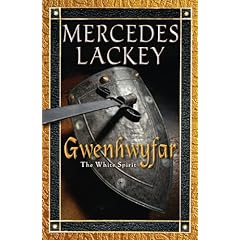
Gwenhwyfar: The White Spirit by Mercedes Lackey

Mercedes Lackey's newest book is called Gwenhwyfar: The White Spirit, and is, as you can probably guess from the title, an Arthurian Legend retelling.

Gwenhwyfar: The White Spirit

Lackey tells the story in her typical easy-to-read, accessible manner, bringing characters and events to life with aplomb. Although Lackey will probably never be recognized for brilliant prose or as divine literature, I love her work and this newest book did not disappoint.

She starts with the historical evidence that there were possibly not one, but THREE queens of Arthur named Gwenhwyfar, and although the story focuses on the third wife, Lackey works in the exploits of the other two, accounting for a lot of the contradictions and busy-ness that Gwenhwyfar would have had to have lived through if it had all been one woman. Lackey does an admirable job of using the wealth of Arthurian legend that is already available, and still spinning her own particular story about Gwen and her life.

Rich in detail, but with an unhampered pace, I recommend this for any of you who have enjoyed Mercedes Lackey's other works, or who love new takes on the Arthurian Legend.


Tuesday, September 7, 2010

Author Recommendation: Juliet Marillier

Who here loves Juliet Marillier? Raise your hands! A lot of you, I'm sure, are happy to see that name come up here, filled with the warm glow of recognition when you see one of your favorite things come up somewhere in the vastness that is the internet. (Admit it, there's a warm glow.)

Starting with one of my absolute favorite books of all times -- an adaptation of one of my very favorite fairy tales:

Daughter of the Forest

Daughter of the Forest is, I want to say, a fairly close representation of The Wild Swans, although Marillier has taken liberties where they fit the story. Set in ancient Ireland, the story is fleshed out with details of the small domain of Sevenwaters, Celtic lore, and early Christian tradition, blending in a beautiful way. Sorcha is the youngest child and only daughter of the Lord of Sevenwaters, who remarries. His new wife turns to sorcery to eliminate his other children, and place her own son as heir. The brothers are turned to swans, and it is up to Sorcha to save them, and herself, from danger both human and supernatural.

Wolfskin

Wolfskin is not as direct a translation of a particular fairy tale, but blends elements of Viking and Orkney mythology. Cultures clash, brotherhood is tested, and love is gained and lost... and perhaps gained again? I don't want to say too much, but there are some beautiful mythological elements, and for those of you who know the Singing Bone/Singing Harp fairy tale, there is a nice inclusion.

Wildwood Dancing

Wildwood Dancing is another beautifully complex piece in Marillier's mythology. This story of five sisters is taken from (have you guessed it yet) The 12 Dancing Princesses. (I guess 12 were too many even for Marillier to wrap her talented story telling around.) From their home in Piscul Dracului in Romania (but don't worry, no sparkly vampires), the girls discover a secret entrance into the Other Kingdom, where they must battle for love and wisdom.

All three of these are counted among my favorite books. Marillier not only retells some of my favorite stories, but she does so with a graceful prose that is hard to come by. Her stories are accessible without the dismissal of the beauty of language I see in a lot of modern fiction. Her captivating writing brings me back to her work as often as her subject matter.

BUT WAIT. THERE'S MORE!

That's right, more. Each of the books above has at least one sequel, so, although she doesn't directly translate other fairy tales in their respective series, she does allow us to continue to dwell in her wonderfully crafted worlds. So if you like those, don't worry, there's more to read after that.

Her website is here, with news and information about upcoming projects.

Monday, September 6, 2010

Prospero Lost by L. Jagi Lamplighter

Prospero Lost

I admit I was initially attracted to Prospero Lost because I was in The Tempest a few years ago, so anything relating to it still catches my eye. This story takes place long after the play, with the idea that Shakespeare knew Prospero, and Prospero told the Bard the tale of his adventures at sea. So the play is part family history for Miranda, Prospero, and the siblings that have come along in the centuries since then.

Miranda Prospero is the daughter of famed Prospero, and in charge of the family business, keeping the elements in line so that the rest of humanity doesn't suffer constant natural disasters. When her father goes missing, leaving a warning for her and her siblings, Miranda sets out to find out what's happening and unearth some family secrets in the meantime.

I really liked the concept behind this book. Although occasionally suffering from an abundance of adverbs, and quite a variety of unnecessary dialog tags, for the most part the writing is fluid and clear. The author pulls in a lot of other fairy tales in small references, like The Well at the World's End (being a key feature in the Prospero family longevity). There's quite a bit of Christmas ... mythology, so I would definitely recommend it for your December reading lists. :)

It is the first book in a trilogy, so be aware of that before you begin!